

Kenya’s latest national household health survey tracks how babies and toddlers are developing. Researchers looked at movement, communication, thinking and social skills, using a World Health Organization measure suitable for children as young as three months.
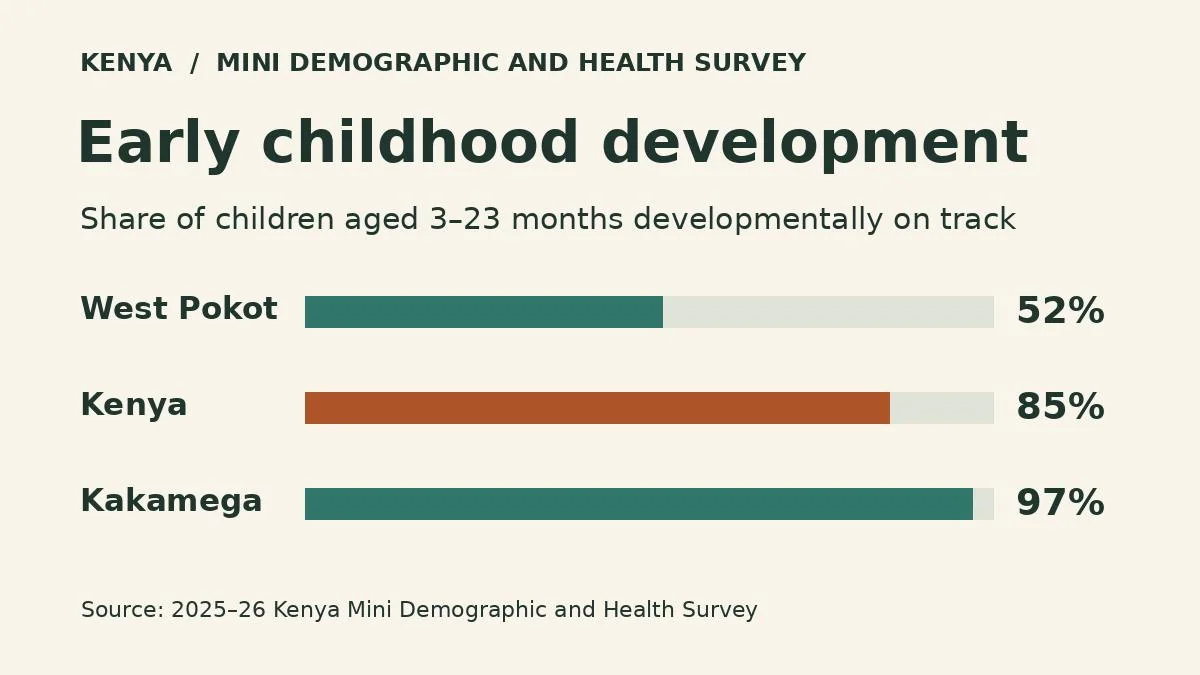
The national picture conceals wide differences between counties. Among children aged three to 23 months, WHO reported that 52 per cent were on track in West Pokot compared with 97 per cent in Kakamega. The findings, presented in Nairobi on 3 November, give county health teams a local baseline for early childhood services.
What the survey actually measured
The Kenya National Bureau of Statistics and the Ministry of Health drew a nationally representative sample of 29,935 households. Fieldwork ran from November 2025 to February 2026. The questions add a dimension to familiar measures such as vaccination, height and weight. A child’s physical growth tells a health worker something different from information about how that child communicates, moves or interacts with other people.
Nationally, 85 per cent of children aged three to 23 months were assessed as developmentally on track. The survey also reported a figure of 83 per cent for children aged 24 to 59 months, using UNICEF’s index for the older group. The two percentages relate to different groups and assessment tools. They cannot establish that the same children fell behind as they grew older. Following individual children over time would require a different study design.
Why the county numbers matter
The difference between West Pokot and Kakamega was 45 percentage points for the younger children. A national average alone cannot show county teams where to look more closely. Equally, a county estimate cannot diagnose an individual child. Its value is in guiding questions about the distribution of support, including where families have access to services and where parents can get advice about early learning.
The report gives officials several other measures against which to consider the development findings. Under-five mortality was estimated at 37 deaths per 1,000 live births, compared with 41 in the 2022 survey. The proportion of births taking place in a health facility rose from 88 to 91 per cent. Those figures describe changes in survival and contact with health services. They do not by themselves explain the differences between counties on developmental milestones.
For planners, the new baseline makes a more specific question possible. A county expanding services for families can ask whether access has improved and, when comparable data are collected again, whether children’s developmental outcomes have changed. Until that next measurement, the figures describe where Kenya stands and where a closer look is warranted.